Best Torque Wrenches: Click, Beam or Digital?
Head bolts, wheel lugs, suspension — the torque wrench is the difference between a job done right and a job done twice. Here's which type to buy and what it should cost.
I've seen more stripped threads and snapped studs from people who "knew" how tight a bolt should feel than from any tool failure. A torque wrench is a measuring instrument, not a strong arm. On a classic, everything from head bolts to wheel lugs has a number in the manual, and most of those numbers matter. This guide covers the three types, honest picks by budget, which drive sizes you need, and how to keep one accurate for years. If you're just stocking the garage, it belongs on the essential garage tools list right next to the socket set.
Why Torque Matters on a Classic
Older cars punish guesswork. Here's where a torque wrench earns its money.
Head bolts. An unevenly tightened head warps the head or block, blows gaskets, even cracks cast iron. Bolts tightened too far stretch and snap. Head bolts also have a tightening sequence, and the sequence is half the job.
Wheel lugs. Too loose and the wheel wobbles and the studs work themselves loose. Too tight and you stretch studs and warp rotors. A torque wrench makes this a 30-second job with no drama.
Suspension. Ball joint nuts, control arm bolts, strut hardware — these hold your car together at speed. Too tight and the joints bind and wear out. Too loose and you get clunks — eventually a joint that lets go.
Aluminum vs steel. This is where classics get tricky. Steel bolts screw into aluminum heads, intake manifolds, thermostat housings, and transmission pans all over these cars. Aluminum threads strip far sooner than steel ones, and the two metals expand at different rates when the engine heats up. That's why aluminum-part specs are written as tight windows. Most specs assume clean, dry threads — add oil or anti-seize and the same torque gives more clamp load, so go easy.
Click, Beam or Digital: The Three Types
Click-type torque wrenches
A spring-loaded mechanism clicks when you reach the set torque. Dial the value, pull until it clicks, stop. Accuracy is around ±3-4% in the middle of its range, which is plenty for restoration work. Durable, uncomplicated, what most garages run on. The catch: you must wind it back to its lowest setting after use so the spring isn't left under tension. Tekton, GearWrench, CDI, and Precision Instruments all make good ones.
Beam-type torque wrenches
A beam wrench is a spring steel bar that flexes, with a pointer and scale. Nothing to wear out. Cheap ($15-$40) and nearly indestructible. Accuracy is around ±5%, and you have to read it at eye level, which is awkward in a wheel well. Fine for lugs and suspension arms, not what I'd use for head bolts. Neiko and Proto make common ones.
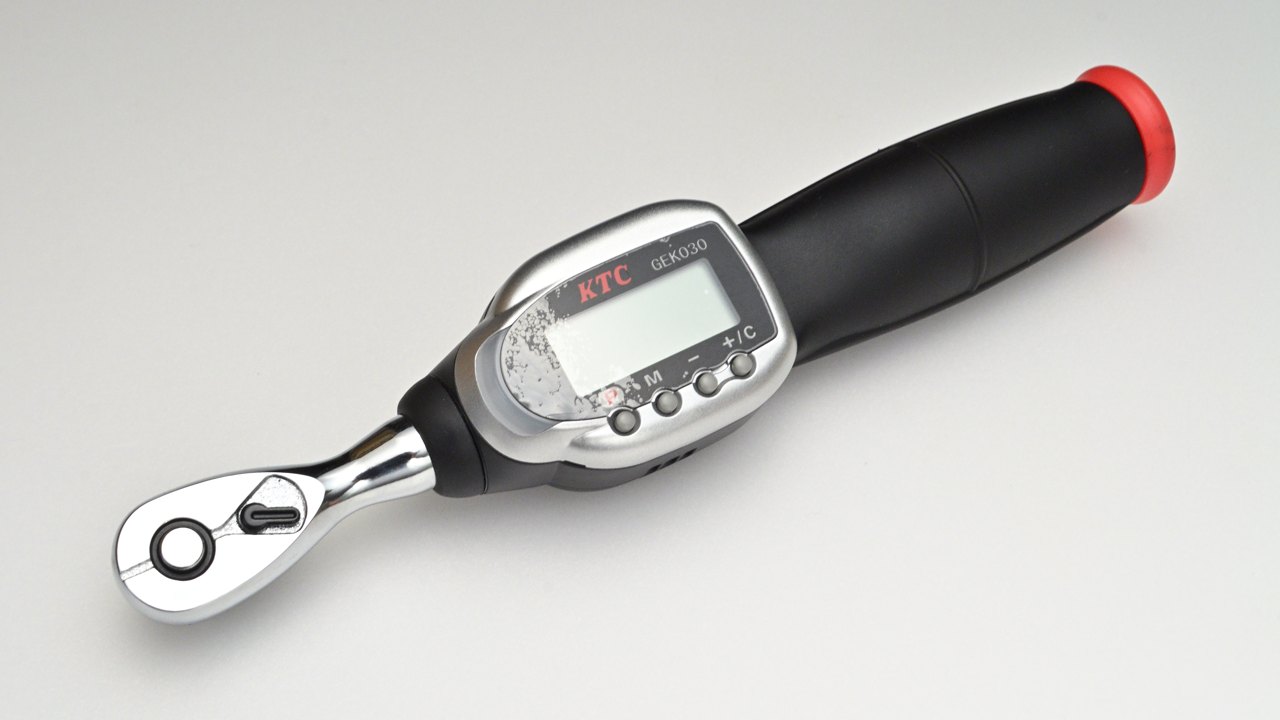
Digital and electronic torque wrenches
A sensor and a screen. Accuracy of ±2-3% (some claim ±1%), a display you can read in bad light, and angle mode for torque-to-angle specs — the "tighten 90 degrees more" instructions on many head bolts. The downsides: batteries, electronics, and more ways to break. Don't drop it. Decent units run $80-$120.
Click vs Beam vs Digital: Side by Side
| Type | Typical accuracy | Price range | Durability | Ease of reading |
|---|---|---|---|---|
| Click | ±3-4% mid-range | $30-$150 (pro $200-$400) | Very good — simple spring mechanism | Good — click plus scale |
| Beam | ±5% | $15-$40 | Excellent — nothing to wear out | Hardest — read at eye level |
| Digital | ±2-3% (some ±1%) | $80-$200 | Good — but electronics and drops | Best — clear display |
My take: click for general work, digital if you're doing engine builds with torque-to-angle specs, beam if you're on a tight budget and mostly doing lugs.
Best Torque Wrenches by Budget
Budget click — Tekton (roughly $40-$60, check current price before buying). The default pick for a reason: accurate enough, crisp click, and they don't fall apart. If you only buy one torque wrench this year, make it a Tekton in 1/2 drive.
Mid-range click — GearWrench (roughly $60-$90, check current price before buying). Better feel and build than the budget tier, still sensible money. The step up without going pro.
Pro-grade click — CDI and Precision Instruments (roughly $90-$150, check current price before buying). CDI is owned by Snap-on, and Precision Instruments builds Snap-on's wrenches. Both use a split-beam design that holds calibration better over years of use. This is the tier I'd buy if the wrench is going to earn its keep.
Digital — (roughly $80-$120, check current price before buying). GearWrench and Neiko both make competent digitals in this band. Buy one for the angle mode if you're assembling engines; otherwise the click wrench above will serve you just as well.
Snap-on (pros only, check current price before buying). Beautiful tools, $300-$500 plus, sold off the truck. If you're turning wrenches for a living, the accuracy and warranty pay for themselves. For a hobby garage, the CDI above gets you 90% of the way for a third of the money.
1/4, 3/8 or 1/2 Drive: You Need Two
Torque wrenches are only accurate in the middle of their range, so you can't buy one and be done.
- 1/4 drive: small fasteners — valve covers, small brackets, anything under about 20 ft-lb. Usually sold in inch-pounds (20-200 in-lb).
- 3/8 drive: intake manifolds, caliper brackets — roughly 10-80 ft-lb.
- 1/2 drive: suspension, head bolts, wheel lugs — the 25-250 ft-lb territory.
So plan on two wrenches: a 1/4 or 3/8 for the small stuff and a 1/2 for suspension and heads. Using a 250 ft-lb max wrench to set a 6 ft-lb valve cover bolt is asking for a stripped thread — the wrench simply isn't accurate down there. A beginner's restoration hits this problem in week one, so buy the pair up front, along with the rest of the essential garage tools.
Calibration and Care
A torque wrench is a precision instrument living in a drawer full of hammers.
Drop it, recalibrate it. A hard drop — bench to concrete, or out of the engine bay — can knock a click wrench off by more than you'd think. If it hits the floor, don't trust it.
Store it at the lowest setting. Click wrenches have a spring under tension. Left set at 100 ft-lb for six months, that spring drifts and the wrench gets sloppy. Wind it down after every job.
Recalibrate yearly if you use it regularly. Calibration services run $30-$60, or check your brand's factory service. Cheaper than a warped head.
Never use it as a breaker bar. The fastest way to wreck the mechanism is to put a pipe over the handle to crack a seized bolt. Crack the bolt with a breaker bar, then switch to the torque wrench.
Pro tip: Paint-pen the calibration date on the handle — "CAL 03/26" on the beam. And if you buy a used torque wrench at a swap meet, treat it as uncalibrated until a shop checks it. The seller's "it's fine" isn't a calibration certificate.
Common Mistakes to Avoid
- Using it as a breaker bar. Ruins the mechanism and the calibration.
- Leaving it set at high torque. Springs drift. Wind it down to minimum after every use.
- Wrong units. Nm, ft-lb, and in-lb are not interchangeable. A 72 Nm spec is about 53 ft-lb — set 72 ft-lb and you've over-torqued by a third.
- Forcing past the click. The click means stop. Pulling another half turn past it is how studs snap.
- Skipping the tightening sequence. Follow the manual's sequence in stages.
FAQ
How often should I recalibrate a torque wrench?
Once a year for regular use, and immediately after any hard drop. Calibration runs $30-$60 and is cheaper than a warped head.
Does storing a click wrench at its lowest setting actually matter?
Yes. The spring stays under tension when the wrench is set high, and over months that tension drifts and affects accuracy. Two seconds to wind it down saves you a recalibration.
What's the difference between ft-lb and in-lb?
Foot-pounds is the common spec for suspension and head bolts; inch-pounds is used for small fasteners and is one-twelfth of a foot-pound. So 120 in-lb equals 10 ft-lb — an easy unit to get wrong, and small fasteners strip before you notice.
Can I use a torque wrench to loosen bolts?
No. It's a tightening tool. Using it to crack seized bolts stresses the mechanism and wrecks the calibration.
Which type is most accurate: click, beam or digital?
Digital is typically the most precise at ±2-3%, click wrenches around ±3-4%, beams around ±5%. But real-world accuracy depends more on using the right size wrench in its accurate range, read properly. A mid-range click wrench used correctly beats a digital used carelessly.
Conclusion
Buy a decent click wrench in 1/2 drive, add a 1/4 or 3/8 for small fasteners, wind it down after every job, and recalibrate after any drop. That's the whole secret — the tool is cheap compared to the parts and time it protects. Whether you're bolting a fresh head on or just torquing lugs after a wheel-off, here at The Barn Find Garage we'd rather see you click twice than strip once. And if you're early in the build, the beginner's guide will keep you moving in the right order.